
Executive Coaching: Is it right for me?

Executive Coaching: Is it right for me?

Executive Coaching: Is it right for me?

By Pete Hall

When you hear the terms “leadership coaching,” “executive coaching,” and “leadership mentoring,” what comes to mind? If you’re like most of us, you start thinking about having a bona fide expert at your side, a skilled veteran in your corner, a wise sage sitting (metaphorically) on your shoulder, whispering advice into your ear. Then you start to wonder:

  • Am I eligible to receive coaching support?
  • Will coaching really benefit me?
  • What would the coaching focus on?
  • Is coaching support worth the investment?

The benefits of executive coaching are plentiful and far-reaching:

Enhancing Leadership Skills:

Leadership is a complex art that requires constant honing and increased self-awareness. Executives who received coaching experienced significant improvements in their leadership competencies. Through one-on-one guidance, executives can identify their strengths and weaknesses, notice blind spots, develop effective communication styles, and refine their decision-making abilities. This personalized approach empowers leaders to adapt to changing business landscapes and inspire their teams, ultimately fostering a culture of innovation and success (Smith, 2025; Collins & Morris, 2020).

Maximizing Performance and Productivity:

Do you ever feel like you’re not reaching your full potential at work? Executive coaching can lead to a remarkable boost in individual performance and productivity. By providing valuable insights and tools tailored to the executive’s unique challenges, coaching helps professionals view options objectively, improve focus, overcome obstacles, and achieve their goals more efficiently. The result? Increased job satisfaction, higher morale, and a direct impact on organizational success (Hu, Choi, & Kim, 2025; Grant & Hartley, 2019).

Accelerating Career Growth:

In today’s competitive landscape, career advancement requires more than just hard work. Executive coaching significantly increases the chances of career progression. By guiding executives in strategic thinking, networking, and cultivating influential relationships, coaching equips individuals with the skills necessary to navigate the intricate web of professional growth. As a result, executives receive greater recognition, access to higher-level opportunities, and the potential for faster promotions (Arruda, 2024; Gentry et al, 2018).

Improving Emotional Intelligence:

The ability to understand and manage emotions is crucial in the corporate world. Executive coaching has a positive impact on the development of emotional intelligence (EQ). Through introspective exercises and feedback, coaching helps leaders develop self-awareness, empathy, self-regulation, and effective conflict resolution skills. By fostering EQ, executives can create a supportive work environment, improve team dynamics, and cultivate stronger relationships with colleagues, leading to higher levels of collaboration and innovation (Druskat & Wolff, 2021).

Financial Benefits:

It’s not just personal growth that executive coaching offers; it can also yield significant financial returns. A study conducted by the International Coach Federation (ICF, 2022) revealed that organizations investing in coaching experienced an average return on investment (ROI) of 7 times the initial coaching cost. Improved leadership effectiveness, increased productivity, and enhanced employee engagement were key drivers of this financial impact. The numbers speak for themselves: executive coaching is an investment that pays off in more ways than one.

If there were a strategy that offered you those outcomes, would you take advantage of it? Right now, you’re probably thinking, What will it cost me? A better question might be, What will it cost me to NOT invest in leadership coaching?

The International Coaching Federation (ICF) reports the following statistics on the benefits of executive coaching:
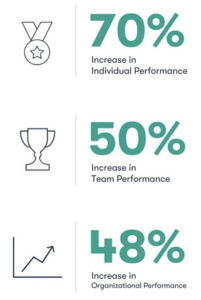
The case is clear

Smart businesses utilize the highest-yield strategies at their disposal to experience success, and executive coaching is a powerful approach with a proven track record. After all, human capital is an organization’s top asset, and executive coaching addresses the growth and capacity-building of people head-on. The next question remains: How can companies prepare, implement, and nurture an executive coaching approach to transform into monumentally successful organizations? Here are four steps:

  1. Build readiness for coaching (culture)

Historically, how are executive coaches utilized? For the most part, coaches are assigned to leaders who are either a) new or b) underperforming. While well-intentioned, this approach inadvertently hamstrings a coaching culture by indicating to all members of the organization that coaching is a reactive strategy used to correct a problem. New leaders don’t know what they’re doing, so they need to be told. Underperforming leaders aren’t good at what they’re doing, so they need to be fixed. Why, then, would anyone want to be a part of coaching? If they’re not new, the message is that they’re ineffective and in need of remediation.

Through careful curation of the organizational culture, leaders can build an environment that is rich in continuous growth, personal development, ongoing learning, and spirited interdependence. Coaching takes hold and leads to transformative practice when the stigma is removed and growth is celebrated. It’s no longer a nice-to-have add-on; it’s an essential part of a company’s leadership acumen. Enhancing relationships, setting and communicating expectations for professional development, and celebrating positive growth nurtures a culture primed for acceleration.

  1. Identify goals & vision up-front (visioning)

Executive coaching is far more effective when the goals and outcomes are identified at the onset of the coaching relationship. Building a common, clear, compelling vision of success prior to engaging in executive coaching allows all the work, discussions, decisions, and reflections to be oriented squarely on the target. This also ensures that in-the-moment coaching is directed toward the agreed-upon goal. Rather than a hodge-podge of unrelated conversations and spotty advice, the result is focused, continuous, relevant work that develops the coach-coachee partnership and leads toward success and effectiveness.

One useful application is to employ the whitewater rafting analogy. When putting one’s raft into the water, the goal is clear: somewhere down the river is the take-out point, and everyone involved would like to arrive safe and sound after a fun excursion. What would make this a spectacularly successful endeavor? Picture it, imagining the outcomes, emotions, and results, and describe success in fine detail. Meanwhile, every rafter knows that at any given moment, there are rapids that must be navigated. Effective executive coaches are able to assist leaders in maneuvering productively through their current rapids while keeping an eye on the ultimate goal: the take-out point.

  1. Focus on reflection, action, and impact (capacity-building)

Typically, executive coaching efforts focus on helping leaders act differently: Here’s a strategy, implement it; take that tool and use it; do this, don’t do that, do it this way. This approach, unfortunately, is why many executive coaching efforts are short-lived and/or fail to reach their goals. An isolated focus on doing things differently restricts the coachee’s ability to plan, decide, assess, and learn from those experiences. These are all hallmarks of a self-reflective coaching approach that yields long-term benefits to individuals and organizations.

What does this look like in action? Quite simply, when executive coaches spend time engaging their coachees in reflective questions designed to enhance their decision-making abilities, attune their skill in assessing the impact of their actions, and augment their proficiency in adapting and adjusting to the results, the outcome is a stronger, more adept, flexible, thoughtful, and deliberate leader. This capacity-building model is a superior approach to many coaching efforts because it builds long-term reflective habits that leaders can generalize and transfer novel situations with remarkable, continued success.

  1. Weave coaching into the daily work (ritualizing)

All leaders have been there before: going about their business, doing their work, when everything pauses and it’s time to engage in a professional-development seminar or a training session of some sort. While these are well-meaning endeavors, nothing beats job-embedded, in-the-trenches professional growth experiences. When coaching becomes a natural, consistent element of day-to-day business, rather than a one-off event, the dividends multiply exponentially.

This means using the self-reflective model as a default method of inquiry when facing challenges, decisions, planning sessions, or any other problem-of-practice in the workplace. Leaders can position team meetings, one-to-one discussions, and presentations as opportunities to question, deliberate, consider, and weigh options for moving forward. By enhancing employees’ reflective habits, the focus of the entire organization becomes concentrated on intentionality, effectiveness, and awareness of every step in the journey.

Executive coaching is for a better, more successful you

Ever since MetrixGlobal’s (2002) study that showed executive coaching had a 529% return on investment for a Fortune 500 company, the breadth and depth of coaching has expanded. A report in Chief Learning Officer journal (2021) indicated that 70% of organizations offer some sort of leadership coaching, and another 22% would like to incorporate coaching into their practice. And it’s really no surprise: It works.

Executive coaching is a proven catalyst for personal and professional growth. Through a tailored approach, leaders can unlock their full potential, enhance leadership skills, and accelerate career growth. Research studies have consistently highlighted the positive impact of coaching on performance, emotional intelligence, and financial outcomes. So, if you’re an ambitious professional looking to thrive in the corporate, educational, nonprofit, or the general working world, consider embracing executive coaching as your secret weapon to reach new heights and transform your career journey.

Pete Hall is the President/CEO of Strive Success Solutions and a certified executive coach. You can reach him via email at Pete@StriveSS.com.

Stay Up To Date

Stay up to date with the latest news updates and blog posts

Share Article

Share this post with your network and friends

Corporate Speaking

Keynote Speaking

Workshops

Individual Coaching

Leadership/Executive Coaching

Personal/Life Coaching

© Copyright Strive Success Solutions 2023. All Rights Reserved.

Closing the three percent gap

Closing the three percent gap

Closing the three percent gap

By guest blogger Brooke Knight

If you’re anything like me, you consider it a paramount responsibility (and a massive personal challenge) to constantly look for ways to close the “3% Gap.” You see, in any given organization, the titled leader (CEO, head coach, manager, person-in-charge, etc.) is responsible for a 3% difference in the organization’s performance. That means, with all other things being equal, a great leader will help the team achieve its identified goals with 3% more success than a not-so-great leader. That’s not much of a difference, is it?

As coaches, executives, and any other positional leaders, we want what’s best for our teams, right? We want to impact the bottom line, whether that’s revenue, expansion, production, reach, or whatever metric we use to gauge our success. It can be challenging to find ways to improve our leadership skills – despite the endless information available in reading material, courses, and online platforms that offer numerous opinions and innovative strategies to help you, as a leader, become Best-in-Class. Sifting through the minutiae can be an arduous task to say the least, and it might actually be distracting us from the work that closes the 3% Gap.

So, before we dig any deeper in the exploration of new and fancy ways to achieve greatness, it is ultra-important we strike a balance and create some self-awareness as it relates to our own role, and how important we are…or are not. There is no question the majority of us love what we do as leaders, though most of the time we are not driven by (nor financially compensated for) the copious hours, the family sacrifices, and the ongoing compassion we exude based on what feeds our souls.

Which brings us to the 3% Gap. There are a lot of variables that contribute to an organization achieving its goals: the right people, at the right time, in the right conditions, can lead to some pretty amazing results. And we know leadership matters. The problem is this: The leaders of winning teams often receive too much credit. On the flip side, when the teams falter, their leaders frequently wear too much of the blame. Remember: even a great leader will only get an organization 3% closer to the goal.

Think of this in terms of sports teams. In collegiate and professional sport, both men and women are paid millions of dollars to fill up that 3% Gap successfully, and some have repeatedly proven their merit in this regard. Off the top of your head, you could probably name a handful of famous, championship-caliber coaches. They’ve traveled the 3% highway for years. And what sets them apart? What do they do to get the most of their 3%? Simply this: since they acknowledge their personal impact is limited, they channel all their energy towards their players, towards building a thriving culture, fostering an unwavering team chemistry, and getting them to jell in pursuit of a common goal.

The best coaches – the best leaders – know it’s not about them. It’s about those they lead.

As a collegiate and professional baseball coach, I consider myself one of the most fortunate individuals on the planet. I’ve had the privilege to communicate, share, love, guide, drive, and challenge some of the very best young human beings – and when we’ve won championships, it’s not because of brilliant coaching, let me assure you. It’s because wedo all we can to put our collective success above anyone’s personal needs. Over the years, I’ve learned from my players, and I’ve looked to steal my own little bits and pieces of gold from each and every one of them. The ongoing exercise in human behavior is never dull, and candidly, there is no perfect recipe or cookie-cutter plan. We are all growing in different directions at different times, and with each new team comes a new group of faces, all with unique strengths and weaknesses. That’s the beauty of the role, and embracing it is paramount for success. If we can’t embrace that, our efforts at mentorship will eat us alive from the inside-out.

I recently learned a very valuable lesson, and one that still doesn’t sit well with me as I type away. This 3% Gap? It’s fragile. Really fragile. Even more than I had previously thought (and why society gives insane value to those who are the best in their respective fields and consistently on the cusp of greatness). I’m not going to get into specifics, but let’s just say that the 3% bounty can’t be pocketed if you don’t have the right souls on the bus. And it doesn’t take more than 1-2 non-invested individuals. I’m not saying for a minute that those who don’t belong on the bus are ‘bad people’. It just means they may not be invested in the road trip the bus has endeavored to explore. If there is any question, character and trust outshine skills and individual performance every time. To ensure the bus arrives at the desired destination, ensuring the right people are on the bus is paramount. You want to win championships in sports and in life? Make sure you have enough talent on the bus, in the room, in the office, on the team. But if your gut is telling you that you can’t trust everyone on the bus to change that flat tire on a sweltering desert day, get them off the bus…even if it means settling for a lower performer who would selflessly change every tire if it meant being a great teammate.

These are lessons I’ve also brought into my role as owner of my mortgage company. I try to instill a mindset that no one is above the team – especially not the leader. Our office is not a hierarchy, it’s a family. I bring great energy every day, no matter what. I treat all the members of the team with respect, showing humility and deferring credit. I learned early in my coaching career: When we win, praise the team. When we lose, take responsibility. The majority of the time these simple actions build trust and provide an opportunity to fill the 3% Gap the right way.

This 3% Gap is a critical piece to every organization. Additionally, for those that retain humility and keep an ongoing growth-oriented mindset, the 3% Gap will never be too far from their fingertips. Don’t be afraid to remind your players, students, employees, and disciples that you are fully aware that your simplified goal is to be exceptional at the 3%. There is no shame in filling our role with great pride, just as we would ask from every coach or player in our organization.

Brooke Knight is a champion: in the corporate world (as a business owner) and in sports (as a baseball coach). He’s been a friend and colleague of Pete Hall’s for many years.

Pete Hall is the President/CEO of Strive Success Solutions. You can reach him via email at Pete@StriveSS.com.

Stay Up To Date

Stay up to date with the latest news updates and blog posts

Share Article

Share this post with your network and friends

Corporate Speaking

Keynote Speaking

Workshops

Individual Coaching

Leadership/Executive Coaching

Personal/Life Coaching

© Copyright Strive Success Solutions 2023. All Rights Reserved.

Use your inner gyroscope to get back on track

Use your inner gyroscope to get back on track

Use your inner gyroscope to get back on track

By guest blogger Derek Garcia

Encyclopedia Britannica describes a gyroscope as “a device containing a rapidly spinning wheel or circulating beam of light that is used to detect the deviation of an object from its desired orientation.” Gyroscopes are used in compasses and automatic pilots on ships and aircraft, in the steering mechanisms of torpedoes, and in the inertial guidance systems installed in space launch vehicles, ballistic missiles, and orbiting satellites.

Although I do not have a spinning wheel inside my brain, I certainly know that I have a desired orientation. I’m aware of my ideal Point B. I also know that as much as I have this desired orientation, I frequently find myself on a path that doesn’t seem to be leading directly toward the intended target.

This is common, because the path to success is rarely linear. There are bumps and detours, distractions and obstacles, pauses and blind turns…and we’re continuously side-stepping, making mistakes, and getting knocked around.

As I am pursuing success in my relationships, business, fitness, and other areas of my life, I find that it can be discouraging – and downright infuriating – when I realize I am not on a perfect path toward my goals. I can be so critical at times that my focus emphasizes the frustration of the present rather than highlighting the possibility of the future. I have to remind myself often of some of the key things that I have learned in order to reach a successful future:

  1. Adjustments are part of the process. Perfection is not attainable. Slight, frequent, deliberate course-corrections are crucial to stay on track. This requires, among other things, clarity of the long-term vision and a mechanism for determining our location and heading in relation to that goal.
  2. Daily recalibration (assessment) is necessary. Research shows that it takes somewhere between 21 and 255 uninterrupted repetitions of a behavior to create a habit. As we develop our desired habits it will take daily discipline and truthful evaluation to continue to make progress.
  3. Short-term choices must line up with long-term vision. We have to continue to ask the question, “Does this choice now, multiplied many times over, lead to my long-term goal?” This can be a tough question to wrangle, because we do a lot of things that provide immediate satisfaction but fall short of the long-range success metric.
  4. Urgency is crucial. If the outcome is truly important to us, we must act like it is. We must corral the emotion and desire of the future goal to fuel our daily, persistent pursuit of what matters most. “The diet starts tomorrow” just won’t work. Do it now.
  5. Start with why. Any goal worth striving for must have a deep-rooted, strong foundation. In order to maintain motivation, we must be genuinely and meaningfully connected to this purpose to help us through the inevitable rough patches.

In my coaching role, I encounter individuals who struggle with these elements all the time. One particular client was interested in completing a marathon for the first time. She had never run more than 15 miles when I started working with her. Early on we identified some form corrections she needed to make to be more efficient. She would complain daily about the difficulty of running in this new way (#1 above). On every run, she had to think about how her feet were landing – slight, frequent changes mile after mile after mile. We would talk about how to meet her marathon goal she needed to continue to put in not just training miles, but intentional training miles (#3 above).

Gyroscopes are fabulous tools for assisting in navigation from Point A to Point B. Metaphorically, you have a gyroscope you can access to help steer you along your journey.

Every week or so, she would tell me she wanted to go back to her old form, but I continued to encourage her to be confident that things would come around. Finally, after about 4 months she was elated to tell me that she hadn’t thought about the changes we made when we first started for two whole weeks. She had built a new habit (#2 above)! 9 months before her marathon and 2 years before she ultimately went on to run the Boston Marathon, she was persistent in making her running efficiency the highest priority (#4 above).

You see, in high school she quit her high school track team because an assistant coach told her that she just wasn’t cut out for running. So at 40 years old, this mom of 2 used finishing a marathon to truly prove to herself that she could do something that she always believed she couldn’t (#5 above).

Your turn

What is it you want? What are your goals, your ambitions, your priorities? Define what you want – with great clarity – and why you want it. Set the big goal and work backwards from there, using these questions as a reflective guide:

1. Why is this so important to you? How can you keep that deep-rooted reason in the forefront of your mind, enabling you to focus and persist?

2. What matters most in this pursuit? What are the most important actions you must make sure you take every day, no matter how hectic or tired or difficult the day may be?

3. What habits are you creating? How can you make sure you maintain the self-discipline to continue to build those helpful habits? Who might help you in this journey?

4. How will you assess your progress along the way? What metrics will you use to determine your success?

5. When you sense you are getting out of alignment with your desired orientation, how quickly are you willing to make a course-correction? And what are you willing to change in order to meet your goals?

Excellence isn’t a sprint; it’s about endurance. Whether you’re mastering a skill, growing as a leader, learning something new, or working toward being a better version of yourself in any of a thousand ways, Just like training for a marathon, you’ve got to take it one day at a time. Use your inner gyroscope to keep you on track until you reach your goals.

Derek Garcia is a former professional triathlete, a personal trainer, and an incredibly good human being. He’s been a friend and colleague of Pete Hall’s for many years.

Pete Hall is the President/CEO of Strive Success Solutions. You can reach him via email at Pete@StriveSS.com.

Stay Up To Date

Stay up to date with the latest news updates and blog posts

Share Article

Share this post with your network and friends