
By Pete Hall

When you hear the terms “leadership coaching,” “executive coaching,” and “leadership mentoring,” what comes to mind? If you’re like most of us, you start thinking about having a bona fide expert at your side, a skilled veteran in your corner, a wise sage sitting (metaphorically) on your shoulder, whispering advice into your ear. Then you start to wonder:
- Am I eligible to receive coaching support?
- Will coaching really benefit me?
- What would the coaching focus on?
- Is coaching support worth the investment?
The benefits of executive coaching are plentiful and far-reaching:
Enhancing Leadership Skills:
Leadership is a complex art that requires constant honing and increased self-awareness. Executives who received coaching experienced significant improvements in their leadership competencies. Through one-on-one guidance, executives can identify their strengths and weaknesses, notice blind spots, develop effective communication styles, and refine their decision-making abilities. This personalized approach empowers leaders to adapt to changing business landscapes and inspire their teams, ultimately fostering a culture of innovation and success (Smith, 2025; Collins & Morris, 2020).
Maximizing Performance and Productivity:
Do you ever feel like you’re not reaching your full potential at work? Executive coaching can lead to a remarkable boost in individual performance and productivity. By providing valuable insights and tools tailored to the executive’s unique challenges, coaching helps professionals view options objectively, improve focus, overcome obstacles, and achieve their goals more efficiently. The result? Increased job satisfaction, higher morale, and a direct impact on organizational success (Hu, Choi, & Kim, 2025; Grant & Hartley, 2019).
Accelerating Career Growth:
In today’s competitive landscape, career advancement requires more than just hard work. Executive coaching significantly increases the chances of career progression. By guiding executives in strategic thinking, networking, and cultivating influential relationships, coaching equips individuals with the skills necessary to navigate the intricate web of professional growth. As a result, executives receive greater recognition, access to higher-level opportunities, and the potential for faster promotions (Arruda, 2024; Gentry et al, 2018).
Improving Emotional Intelligence:
The ability to understand and manage emotions is crucial in the corporate world. Executive coaching has a positive impact on the development of emotional intelligence (EQ). Through introspective exercises and feedback, coaching helps leaders develop self-awareness, empathy, self-regulation, and effective conflict resolution skills. By fostering EQ, executives can create a supportive work environment, improve team dynamics, and cultivate stronger relationships with colleagues, leading to higher levels of collaboration and innovation (Druskat & Wolff, 2021).
Financial Benefits:
It’s not just personal growth that executive coaching offers; it can also yield significant financial returns. A study conducted by the International Coach Federation (ICF, 2022) revealed that organizations investing in coaching experienced an average return on investment (ROI) of 7 times the initial coaching cost. Improved leadership effectiveness, increased productivity, and enhanced employee engagement were key drivers of this financial impact. The numbers speak for themselves: executive coaching is an investment that pays off in more ways than one.
If there were a strategy that offered you those outcomes, would you take advantage of it? Right now, you’re probably thinking, What will it cost me? A better question might be, What will it cost me to NOT invest in leadership coaching?
The International Coaching Federation (ICF) reports the following statistics on the benefits of executive coaching:
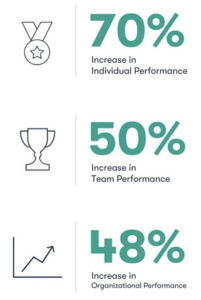
The case is clear
Smart businesses utilize the highest-yield strategies at their disposal to experience success, and executive coaching is a powerful approach with a proven track record. After all, human capital is an organization’s top asset, and executive coaching addresses the growth and capacity-building of people head-on. The next question remains: How can companies prepare, implement, and nurture an executive coaching approach to transform into monumentally successful organizations? Here are four steps:
- Build readiness for coaching (culture)
Historically, how are executive coaches utilized? For the most part, coaches are assigned to leaders who are either a) new or b) underperforming. While well-intentioned, this approach inadvertently hamstrings a coaching culture by indicating to all members of the organization that coaching is a reactive strategy used to correct a problem. New leaders don’t know what they’re doing, so they need to be told. Underperforming leaders aren’t good at what they’re doing, so they need to be fixed. Why, then, would anyone want to be a part of coaching? If they’re not new, the message is that they’re ineffective and in need of remediation.
Through careful curation of the organizational culture, leaders can build an environment that is rich in continuous growth, personal development, ongoing learning, and spirited interdependence. Coaching takes hold and leads to transformative practice when the stigma is removed and growth is celebrated. It’s no longer a nice-to-have add-on; it’s an essential part of a company’s leadership acumen. Enhancing relationships, setting and communicating expectations for professional development, and celebrating positive growth nurtures a culture primed for acceleration.
- Identify goals & vision up-front (visioning)
Executive coaching is far more effective when the goals and outcomes are identified at the onset of the coaching relationship. Building a common, clear, compelling vision of success prior to engaging in executive coaching allows all the work, discussions, decisions, and reflections to be oriented squarely on the target. This also ensures that in-the-moment coaching is directed toward the agreed-upon goal. Rather than a hodge-podge of unrelated conversations and spotty advice, the result is focused, continuous, relevant work that develops the coach-coachee partnership and leads toward success and effectiveness.
One useful application is to employ the whitewater rafting analogy. When putting one’s raft into the water, the goal is clear: somewhere down the river is the take-out point, and everyone involved would like to arrive safe and sound after a fun excursion. What would make this a spectacularly successful endeavor? Picture it, imagining the outcomes, emotions, and results, and describe success in fine detail. Meanwhile, every rafter knows that at any given moment, there are rapids that must be navigated. Effective executive coaches are able to assist leaders in maneuvering productively through their current rapids while keeping an eye on the ultimate goal: the take-out point.
- Focus on reflection, action, and impact (capacity-building)
Typically, executive coaching efforts focus on helping leaders act differently: Here’s a strategy, implement it; take that tool and use it; do this, don’t do that, do it this way. This approach, unfortunately, is why many executive coaching efforts are short-lived and/or fail to reach their goals. An isolated focus on doing things differently restricts the coachee’s ability to plan, decide, assess, and learn from those experiences. These are all hallmarks of a self-reflective coaching approach that yields long-term benefits to individuals and organizations.
What does this look like in action? Quite simply, when executive coaches spend time engaging their coachees in reflective questions designed to enhance their decision-making abilities, attune their skill in assessing the impact of their actions, and augment their proficiency in adapting and adjusting to the results, the outcome is a stronger, more adept, flexible, thoughtful, and deliberate leader. This capacity-building model is a superior approach to many coaching efforts because it builds long-term reflective habits that leaders can generalize and transfer novel situations with remarkable, continued success.
- Weave coaching into the daily work (ritualizing)
All leaders have been there before: going about their business, doing their work, when everything pauses and it’s time to engage in a professional-development seminar or a training session of some sort. While these are well-meaning endeavors, nothing beats job-embedded, in-the-trenches professional growth experiences. When coaching becomes a natural, consistent element of day-to-day business, rather than a one-off event, the dividends multiply exponentially.
This means using the self-reflective model as a default method of inquiry when facing challenges, decisions, planning sessions, or any other problem-of-practice in the workplace. Leaders can position team meetings, one-to-one discussions, and presentations as opportunities to question, deliberate, consider, and weigh options for moving forward. By enhancing employees’ reflective habits, the focus of the entire organization becomes concentrated on intentionality, effectiveness, and awareness of every step in the journey.
Executive coaching is for a better, more successful you
Ever since MetrixGlobal’s (2002) study that showed executive coaching had a 529% return on investment for a Fortune 500 company, the breadth and depth of coaching has expanded. A report in Chief Learning Officer journal (2021) indicated that 70% of organizations offer some sort of leadership coaching, and another 22% would like to incorporate coaching into their practice. And it’s really no surprise: It works.
Executive coaching is a proven catalyst for personal and professional growth. Through a tailored approach, leaders can unlock their full potential, enhance leadership skills, and accelerate career growth. Research studies have consistently highlighted the positive impact of coaching on performance, emotional intelligence, and financial outcomes. So, if you’re an ambitious professional looking to thrive in the corporate, educational, nonprofit, or the general working world, consider embracing executive coaching as your secret weapon to reach new heights and transform your career journey.
Pete Hall is the President/CEO of Strive Success Solutions and a certified executive coach. You can reach him via email at Pete@StriveSS.com.
Stay Up To Date
Stay up to date with the latest news updates and blog posts
Share Article
Share this post with your network and friends
Corporate Speaking
Keynote Speaking
Workshops
Individual Coaching
Leadership/Executive Coaching
Personal/Life Coaching
© Copyright Strive Success Solutions 2023. All Rights Reserved.
Recent Comments